
Pipe Repair
The plumbing system in your home is a complex network of pipes, valves, and lines that work together to deliver clean water and remove waste. Most of the time, these pipes are out of sight and out of mind, hidden behind walls, under floors, or buried underground. However, when a pipe fails, it quickly becomes the center of attention. At Crowley Plumbing Co, we specialize in comprehensive pipe repair, pipe installation, and main water line services. We are dedicated to maintaining the integrity of the plumbing infrastructure for residents and businesses throughout Crowley.
Pipe repair in Crowley for slab leaks and copper lines
When a supply line fails, Crowley Plumbing Co handles pipe repair in Crowley, TX for homes and businesses in houses, townhomes, condos, and businesses, and we take the same residential calls in Cresson. We stay with that work 24/7, including nights when a closet line opens. The same crew that already knows the builder layouts also handles emergency plumbing, water heater repair, drain cleaning, fixture installation, garbage disposal repair, and tankless water heaters when those jobs sit beside the leak.
In 76036 the house is often a slab, and the story we hear first is a warm floor or copper that has already had one pinhole patch. Crowley Original Town still hides galvanized and cast iron from earlier decades, while later streets around Lasater Ranch run copper, PVC, and PEX that fail in different ways.
We pressure-test and isolate the wet branch before we cut, and we show you the reading so a section repair versus a repipe is not a surprise. We leave the house swept, with the shutoff labeled if we had to hunt for it, and we do not walk out while a joint is still weeping. Next comes the shutoff and the short list of checks that will not make the leak worse.
- OUR PROCESS
What to Expect When You Call for Plumbing Service
From the first call to the final check, Crowley Plumbing Co keeps the plumbing service process simple, clear, and focused on solving the problem correctly.
1. Schedule Your Plumbing Service
Tell us what’s going on and choose a convenient time for your plumbing repair or service.
2. Inspection & Professional Repair
We inspect the issue, explain the recommended solution, and complete the necessary plumbing repair or installation.
3. Final Testing & Quality Check
We test the plumbing system, check our work, and make sure everything is operating properly before we finish.
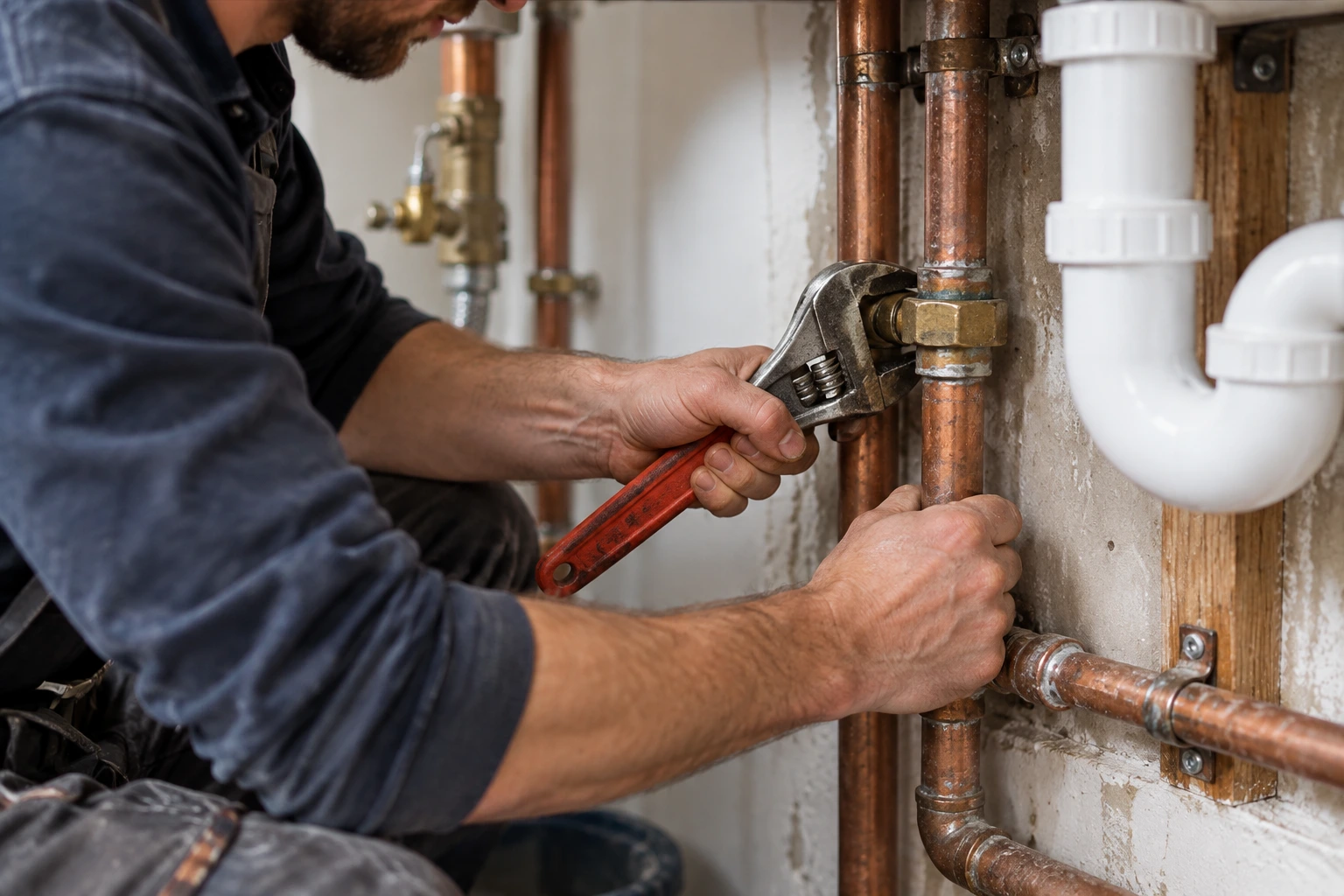
What to do first when a pipe fails
The first minutes belong to stopping the water, not to opening a wall. On these streets the valve is sometimes at the meter, sometimes in a garage, and sometimes in a spot the last remodel hid. Once flow stops, a few calm checks tell us what to bring, and a few habits make the stain bigger. The steps below are the ones we ask for on the first call so the visit starts on isolation instead of on a flooded closet.
Find the house shutoff before the water spreads
Look at the meter box near the street and at the wall on the house side of that box. Later Crowley builders often put the valve in the garage, but Original Town houses hide it in a closet or behind a water heater closet door. If you cannot find it, stop at the meter and do not keep hunting while water is still moving. Tell us what you tried so we do not spend the first ten minutes repeating that search.
Checks that are safe while the truck is rolling
These are the observations that help us pack the right couplings and decide whether the leak is in the house or in the yard.
- Note whether the water meter still spins after every fixture is off.
- Feel for a warm tile, a cool hiss, or a wet baseboard and remember which room it is.
- Look at the ceiling below an upstairs bath without poking the bulge.
- Open one hose bib after the house valve is closed to bleed pressure from the lines.
- Photograph the stain and the nearest shutoff so we can match it to the builder layout.
Moves that make a leaking pipe worse
Leave the finish and the fittings alone until we have a pressure reading. Tightening a green copper joint or driving a screw into a bulge usually turns a small opening into a spray.
- Do not crank a valve that has not moved in years until it snaps in your hand.
- Do not tape a pinhole and turn the water back on to see if the tape holds.
- Do not cut drywall to follow a stain, because the wet path is often a bay away.
- Do not run the washer or dishwasher to test pressure while a line is still open.
- Do not pour hot water on a frozen garage run; let us thaw and inspect the split.
Pipe problems we see in Crowley houses
Most of the calls we take for lines fall into a short list: a burst, a stain in a wall or ceiling, freeze damage, a house that is ready for new pipe, a wet run in the yard, weak flow, copper pinholes, or a warm slab. Each one has a different first test, and the housing around it changes what we expect to find.
Burst pipes
A burst turns a supply line into an open hose, and in a Crowley slab house the water often runs to the lowest closet or the garage before anyone sees it. Poorly insulated garage and closet runs are the winter version. A nail or a shifted hanger is the everyday version, and the longer the valve stays open, the more finish we dry after the pipe work.
Signs it is time to call
- A sudden spray from a closet, garage, or sink cabinet.
- Water rolling under the baseboards while a hiss is still going.
- A ceiling that sags and keeps dripping after you shut a single fixture.
- Ice on a garage line that then weeps along a split.
- The meter spinning hard with every tap already off.
- A wet attic tray over a bathroom after a hard freeze.
We shut the house down, find the split, and decide whether a coupling will hold or the whole branch is fatigued. Burst pipe repair on a sound PEX or copper run is a section job with a pressure test after the joint. If the rest of the line will not hold, we stop talking about a patch and walk you through the next opening. An active dump at night belongs with our emergency plumbing crew on that first hour.
Leaking pipes in walls or ceilings
A slow leaking pipe inside a wall can stain for weeks before the drywall gives up. Upstairs baths in two-story Crowley houses send that water to the ceiling below, which is why people ask for a plumber for a leaking ceiling when the real opening is a supply fitting one room over. We treat the stain as a map, not as the leak itself.
What you might notice first
- A brown ring that grows after laundry day.
- Paint that bubbles along a shower wall that is not the shower itself.
- A musty closet that sits on a supply chase.
- Drywall that feels cool and soft in one bay only.
- A drip that starts when a toilet is flushed upstairs.
- Flooring that cups under a vanity with no puddle on the cabinet floor.
To fix a leaking pipe in the wall we isolate that branch, confirm the wet fitting, and open only the bay that holds it. Copper pipe repair at a joint can be a short new piece if the rest of the run holds. If the stain returns two bays over, the conversation shifts from one coupling to the whole branch.
Frozen pipe repair after a hard freeze
Hard freezes hit poorly insulated garage and closet runs first, and longer yard lines on larger lots such as Horse Creek Farms take longer to recover. Ice does not have to burst the pipe in the moment you notice it. A hairline split can weep for days after the thaw, which is why frozen pipe repair in winter includes a pressure test, not just a heat gun.
How this shows up in the house
- No water at a far bath after a night below freezing.
- A garage line that sweats and then sprays at one elbow.
- A hose bib that will not flow until late morning.
- A closet riser with a split on the uninsulated face.
- Several rooms that come back at different times as ice lets go.
- A new stain that appears the afternoon after the thaw.
We thaw only enough to see the opening, then we cut out the damaged length and replace it with material that matches the rest of the branch. Frozen pipe repair is still a supply job, so we cap and test before we restore the house. Insulation and a better route come after the joint holds, not before.
Repiping whole houses
Repiping is the point when patching stops saving time. In Crowley that often means galvanized that has closed down, polybutylene still in the walls, or copper that keeps opening pinholes after the last repair. Homes and businesses feel it as brown water at the far bath, weak upstairs showers, and a stain that moves to a new room each season.
Clues around the fixtures and walls
- Two or more rooms that have already had a coupling this year.
- Gray plastic supply with failed fittings behind access panels.
- Rust flakes in aerators on a galvanized house.
- Hot and cold that take a long time to arrive at the same sink.
- Access holes from earlier patches that never quite matched the stain.
- A pressure test that will not hold on more than one branch.
PEX repiping is how we usually rebuild supply in this housing, with attic routes when the slab is intact and wall routes when finish is already open. Galvanized pipe replacement and polybutylene replacement are named as whole-house work because one new fitting does not change the rest of the material. When a house needs a full repipe, we plan the week so you can still cook and flush while the new lines go in. Some households pair that week with tankless water heaters so the heater and the pipe age together.
Water line repair on the run to the house
The buried run from the meter to the slab is its own job. Clay movement and traffic in the yard will crack a service line while every pipe inside the house still looks dry. Main water line repair starts at the meter, not at the kitchen sink, and water line replacement is on the table when the pipe will not hold after one coupling in the trench.
Early warnings in the yard
- A soft spot or green strip between the meter and the house.
- The meter moving with every indoor fixture off and the house valve closed.
- Low flow at every tap, including the hose bibs.
- A hiss you can hear at the meter box.
- Mud at the slab edge after a day with no rain.
- A water bill that jumped while the interior stays dry.
We isolate the house from the service line so we know which side is wasting water. A short water line repair in the yard is a trench, a new section, and a pressure test at the meter. If the material is tired along the whole run, we talk about water line replacement in one opening rather than a chain of small holes across the lawn.
Low water pressure from pipe problems
Low water pressure in the whole house is often the pipe, not the faucet. Galvanized pipes rusting from the inside close the bore until the far bath is a trickle. A kinked PEX run or a scaled service line can do the same thing on a newer street, and summer irrigation on city water makes the weak flow easier to notice.
What the fixtures start doing
- Both hot and cold weak at the same time in every room.
- An upstairs shower that dies when the washer fills.
- Aerators that catch rust or white scale every few weeks.
- One hose bib that is strong while the house is weak, or the reverse.
- A toilet that fills slowly after you already changed the fill valve.
- Flow that improved for a day after we opened a nipple, then faded again.
We measure static pressure at the house, then flow at the farthest fixture, so we do not chase trim. If galvanized is the choke, section work on one nipple is a short relief and galvanized pipe replacement is the lasting one. If a pressure reducing valve is stuck closed, the fix is the valve, and the pipes can stay.
Pinhole leaks in copper
Pinhole leaks in copper pipes are small until the drywall is ruined. Moderately hard to hard city water thins the tube from the inside, and high pressure at a stuck reducing valve speeds that up. Lasater Ranch copper from the late 1990s and 2000s still sees this, and so does older copper in the core of town.
Sounds and stains that point to pipes
- A green crust at a joint that weeps when the house is quiet.
- A pin-sized spray on a straight run, not only at a fitting.
- Repeated patches on the same hallway ceiling.
- Washers that fail early while the copper looks bright on the outside.
- A warm spot that tracks a copper loop in the slab.
- Blue-green staining in a tub that has no other leak source.
The unique first check on these Crowley slabs is the pressure reducing valve on the house side of the meter, often near a hose bib, because we record static pressure there before we open a wall for copper pipe repair. One pinhole on a sound run can take a coupling. A second pinhole on the same floor usually means the copper is the pattern, not the accident.
Slab leaks under the floor
A slab leak under the floor is the warm-spot call. Water leaves a supply loop in the concrete, heats a tile path, and sometimes never shows as a puddle. Shrink and heave in the clay under Crowley slabs stress those loops, which is why a house can be dry for years and then wet along one hallway after a long dry spell.
What tends to show up underfoot
- A strip of floor that stays warm with the heat off.
- A hollow or soft place in vinyl or tile over a known pipe path.
- The water bill went up with no leak visible in any room.
- A hiss you can hear if you put an ear to the floor at night.
- Mold smell at a baseboard with no roof stain above it.
- Hot water that arrives at a far bath faster than it used to, then fades.
Slab leak repair starts with the meter test and a surface map, not with a saw. If the loop is the only failure and the rest of the house holds, we open that path and reroute. If copper in the slab is pinholing in more than one place, we treat it as a reason to lift supply out of the concrete rather than to chase heat across the floor.
Section repair versus a whole house repipe
The choice that matters on a Crowley pipe job is whether we replace a section or repipe the house. A single split on a copper run in a garage wall can take a coupling and a short new piece if the rest of the line holds pressure and the wall is dry beyond that bay. A second pinhole three feet over, or green staining at several joints, usually means the copper has thinned from hard city water and from the way the Sanger soil series moves a slab. A new six-inch patch will not change the next failure on that floor.
Galvanized pipe replacement is a different fork. In Crowley Original Town, galvanized pipes rusting from the inside will keep dropping pressure at the far bath even after we open one clogged nipple. If two fixtures on one floor are already starved, we talk about repiping an older home rather than chasing rust room by room. Polybutylene from the late 1970s through the mid-1990s, where it still sits in walls, gets the same conversation: one failed fitting is a warning about the rest of the gray plastic, not a reason to hide a new barb behind paint.
PEX repiping is how we usually rebuild supply in this housing. We route PEX in attics when the slab is intact and the walls are finished, we drop it in walls when we already have the finish open, and we only go into the slab when a leak is already under the floor and that path is the clean repair. A pressure reducing valve, which steps city pressure down at the house, gets tested before we blame the copper, because high pressure blows washers and starts pinholes that look like a pipe disease. Fixture failure after a repipe is often that valve still stuck open, so it stays on the checklist until the last day.
When a house needs a full repipe, the week looks like this. Day one is isolation, fixture protection, and marking the attic or wall path so you still have a working hose bib or a tagged temporary for cooking and flushing. The middle days are the new runs and the tie-ins at the hot water heater and the manifold. The last day is a pressure test, restoring heat, and opening every tap so you see flow before we pack up. You live in the house. We do not ask you to move out for supply work. That is the fork we own: a tight section when the rest of the system is sound, and a planned repipe when the next leak is already written into the pipe.
How we work a pipe job in your house
The first call is about shutoffs and what you are seeing
We ask which rooms are wet, whether the meter is still moving, and whether you found the shutoff nobody can find on the first try. Those answers tell us if this is a yard line, a wall stain, or a slab path, and they tell us which couplings and isolation tools leave the shop. The shop sits at 203 N Hampton Rd, so the truck is already on the same streets as most of these layouts. You get a window, not a mystery van, and you know what we will test first.
How we set the visit and what arrives on the truck
Once the water is off or slowed, we set the arrival so someone can walk us to the stain and the valve. The truck carries press tools, copper and PEX repair stock, a gauge for static pressure, and the camera we use only when a drain, not a supply line, is in doubt. Isolation usually takes the first forty to sixty minutes. If the leak is still dumping, we stay on that shutoff until the house is quiet before we talk about openings.
Testing before we cut, then a clear choice
Gauges go on before saws. We record static pressure at the reducing valve, watch the meter, and cap branches until the wet one reveals itself. That is the moment we say whether a section will hold or whether the house is telling us to repipe. You see the reading and the wet fitting, not a shrug in a hallway. The crew that found the builder shutoff is the same crew that will open the wall, so the story does not change between the test and the repair.
Repair, the last pressure check, and how we leave
After the joint is in, we bring the house back up slowly and watch the gauge. Every tap we named on the first call gets opened with you in the room. Debris leaves in the truck, valves get labeled if they were the hard ones to find, and the floor is dry enough to walk. If a stain still needs time to dry, we say so instead of painting over it. The drip, the tank, and the slab stay with that same crew if the next call is a heater or a fixture, not a new set of strangers.
One crew for the slab house and the fixture that failed with it
Pipe work here is rarely only the pipe. High pressure that started a pinhole often ruined a washer the same month, and hard water that thinned copper also scaled the hot water heater. We keep that whole-house view so you are not scheduling three visits for one failure. Builder layouts on these streets, and the older shutoff spots in Original Town, are already in the crew’s head when the door opens.
Where we work and what the lines face
Pipe work in Crowley lives with three loads that show up on almost every visit. The Sanger soil series shrinks when it dries and heaves when it wets, so slab-on-grade houses and the buried service line move enough to crack joints. City of Crowley water is purchased treated surface water that runs moderately hard to hard, which scales heaters and thins copper until pinholes open. Summer irrigation on that same supply raises demand so low flow and scale show up together, which is why we measure pressure before we assume a fixture is the whole story.
Streets and houses we keep seeing
Crowley Original Town along the downtown civic core still carries galvanized and cast iron in mixed stock from the early plats, and those houses are where we hunt shutoffs that later builders would have put in the garage. Lasater Ranch and similar later streets run copper, PVC, and PEX, so the failures there are pinholes, slab movement, and the occasional poor attic route. Horse Creek Farms and the Deer Creek corridor add longer buried runs on larger lots, which is why a yard leak can look like a house problem until we isolate at the meter. FM 731, also called Crowley Road, and Main Street, the historic civic corridor, are the two spines we use to describe where a house sits when we plan the trench or the attic path. The city is mainly in Tarrant County with a small extension across the line between Tarrant County and Johnson County, and that edge does not change how we test a pipe, only which appraisal map the lot sits on.
Pipe repair in Cresson
Cresson is not a Crowley suburb with the same taps. It sits at the Hood, Johnson, and Parker county corners, City of Cresson serves Cresson Proper and Bluebonnet Hills, and other pockets run on separate operators, so pipe repair starts by asking who sells the water and what the static pressure is at that meter. Along US 377 and SH 171 we still isolate, test, and choose a section or a repipe, without borrowing Original Town galvanized as the default story. A plumber in Cresson visit follows that utility split rather than copying Crowley housing onto those roads.
Work that sits next to pipe repair
When the break is the building drain or the sewer rather than a supply line, drain cleaning is the right visit, and we treat that as a referral instead of the lead. Supply pipe repair will not clear a sewer, and a cable will not hold pressure on a split copper run.
Scale from the same hard water that thins copper often shows up first at the tank, so water heater repair is the page to use when the pipe is sound and the heater is the weak piece. We will still check the reducing valve, because a heater that dumps its T&P valve, which relieves pressure on the tank, can be a pressure problem rather than a tank problem.
Washers, stops, and faucets that failed under high pressure get replaced after the line holds, and that trim work lives on our fixture installation page. Replacing a faucet will not raise flow if galvanized is closed down, so we keep those jobs in that order.
Questions about leaks and burst pipes
When is a clamp the wrong fix for a leaking pipe?
A clamp is a pause when the pipe around it is already thin or stained. If copper shows green at several joints, or galvanized drops rust into the aerator, the next leak is already in that run. On Crowley slabs a rigid patch can also shear when the clay dries and the line moves, so we pressure-test the rest of the branch before we call a coupling a repair. A sound stretch of copper or PEX can take a short new piece. A run that has opened twice should come out so you are not painting over the same stain next season.
What does a plumber near me check first when a pipe warms the floor?
The first checks are the meter and the isolation valves, not a saw in the slab. A spinning meter with every fixture off means water is leaving the system, and a warm tile often sits over that path. We map the hot spot, confirm it is supply, and only then talk about opening the floor. That order keeps us from cutting a loop that is not leaking. It also shows whether a pressure reducing valve, which steps pressure down at the house, is passing a surge that started the pinhole.
Why would the water bill rise if I cannot see a leak?
A hidden supply leak will move the meter even when every tap is closed, so the bill climbs while the floor still looks dry. Slab leaks and yard lines are the usual reason in Crowley because water can run under the house or into clay without a puddle you would notice. We read the meter, isolate the house from the service line, and listen at hose bibs to see which side is wasting water. If the house side holds and the yard side does not, the search moves to the run from the meter. That is main water line leak repair, not a fixture washer.
Do banging pipes in the walls mean I should shut the water off?
Banging is often water hammer from a fast-closing washer or from a line that has come loose on a hanger, and it does not always mean a burst is seconds away. If you also see a wet spot, hear hissing, or lose pressure, shut the house valve and wait for us. In winter a bang can be ice moving in a poorly insulated garage or closet run, and that is a different risk. We will check supports, the pressure reducing valve, and whether a hammer arrestor failed. Do not keep cycling a valve that slams just to see if the noise stops.
Questions about pressure and repiping
When does an older home in Crowley need a full repipe?
An older Crowley house needs a full repipe when two or more branches have failed, when galvanized is rusting from the inside across a floor, or when polybutylene is still in the walls. One pinhole can be a section. Repeated pinholes, brown water at the far bath, and low water pressure in the whole house together mean the piping, not one fitting, is finished. Original Town stock from before the mid-1970s is where we see that pattern most. We show you the openings and the pressure readings so the choice is based on the house you have, not on a habit of patching.
How is PEX routed during a repipe week in a slab house?
On a Crowley slab we prefer PEX in the attic or in walls we already have open, and we go into the slab only when the leak is already under the floor. Day one is protection, isolation, and marking the path so you can still cook and flush. The middle of the week is the new runs, the tie-ins at the hot water heater, and the manifold if the layout needs one. The last day is a pressure test and opening every tap with you in the room. You live at home through it; we do not ask you to move out for supply work.
Can high pressure at the fixtures come from the pipes themselves?
Yes. High pressure at the street will beat washers to death and start pinhole leaks in copper even when the pipe looks clean. A pressure reducing valve at the house is the usual control, and when it sticks open the whole system runs too hard. Low water pressure in the whole house is the other side of the same coin: galvanized that has closed down, a kinked PEX run, or a service line that has scaled. We measure static pressure first, then flow at the farthest bath, so we do not replace a faucet that was never the cause.
Is pipe work in Cresson billed by the same water utility as Crowley?
No. Cresson sits at the Hood, Johnson, and Parker county corners, not in Tarrant County, and City of Cresson serves Cresson Proper and Bluebonnet Hills while other pockets use separate operators. Pipe repair there still starts with isolation and a pressure test, but we do not assume Crowley water chemistry or Crowley Original Town galvanized. Along US 377 and SH 171 the housing is generally newer than the 1882 Crowley plat, so we look for copper, PVC, and PEX first. Different seller, different county, same need to see the failed line before we cut.
Crowley Plumbing Co keeps pipe repair in Crowley on the same crew that already knows the slab layouts, the older shutoff spots, and the difference between a coupling and a week of PEX. Burst lines, wall stains, freeze splits, yard services, weak flow, copper pinholes, and slab leaks all start with isolation and a gauge, then a clear choice about the section in front of us. If you want the wider roster, our plumbing services in Crowley list the rest of the house, and the Crowley plumber home page is the front door for a first visit. We will show you the wet fitting and the pressure reading before we cut.
Reach out to us for assistance.
Service ZIPs: 76036, 76035
- NEED PLUMBING HELP?
Plumbing Problem? Call Crowley Plumbing Co Today
From clogged drains and leaking pipes to water heaters, sewer lines, and emergency plumbing, our team provides reliable plumbing service for homes.