
Water Heaters
Hot water is an essential part of modern living. From a warm shower in the morning to running the dishwasher after dinner, your water heater works silently in the background to provide comfort and sanitation. When this system fails, it is immediately noticeable and highly disruptive. At Crowley Plumbing Co, we specialize in comprehensive water heater repair and installation services. We are dedicated to ensuring that the residents and businesses of Crowley have reliable access to hot water year round.
Water heater repair in Crowley garage and closet tanks
When a garage hot water heater goes loud, rusty, or out of hot water by the third shower, Crowley Plumbing Co steps in for water heater repair in Crowley, TX for houses, townhomes, condos, and businesses, and we take the same tank calls in Cresson. Homes and businesses in 76036 call about closets that drip, burners that will not fire, and tanks that cannot keep up with morning showers. We also handle drain cleaning, pipe repair, fixture installation, garbage disposal repair, emergency plumbing, and water heater installation when the rest of the house is part of the story.
On the streets around Crowley Original Town the same crew already knows the builder layouts and the shutoff nobody can find behind a tight garage tank. City water here runs moderately hard to hard, so scale shortens recovery and eats at fittings. We test before we cut, we leave the garage swept, and we are available 24/7 when there is no hot water after hours. From the first call we walk through what you will see and how long a first check usually takes.
The next section covers the safe checks at the tank before anyone opens a panel. After that we walk through the failures we see on these streets, from sediment to a leaking water heater. Then we explain how a visit runs and how we decide between a repair and a replacement. If the house also has a drain or a supply issue, we treat that as part of the same visit rather than a separate mystery.
- OUR PROCESS
What to Expect When You Call for Plumbing Service
From the first call to the final check, Crowley Plumbing Co keeps the plumbing service process simple, clear, and focused on solving the problem correctly.
1. Schedule Your Plumbing Service
Tell us what’s going on and choose a convenient time for your plumbing repair or service.
2. Inspection & Professional Repair
We inspect the issue, explain the recommended solution, and complete the necessary plumbing repair or installation.
3. Final Testing & Quality Check
We test the plumbing system, check our work, and make sure everything is operating properly before we finish.
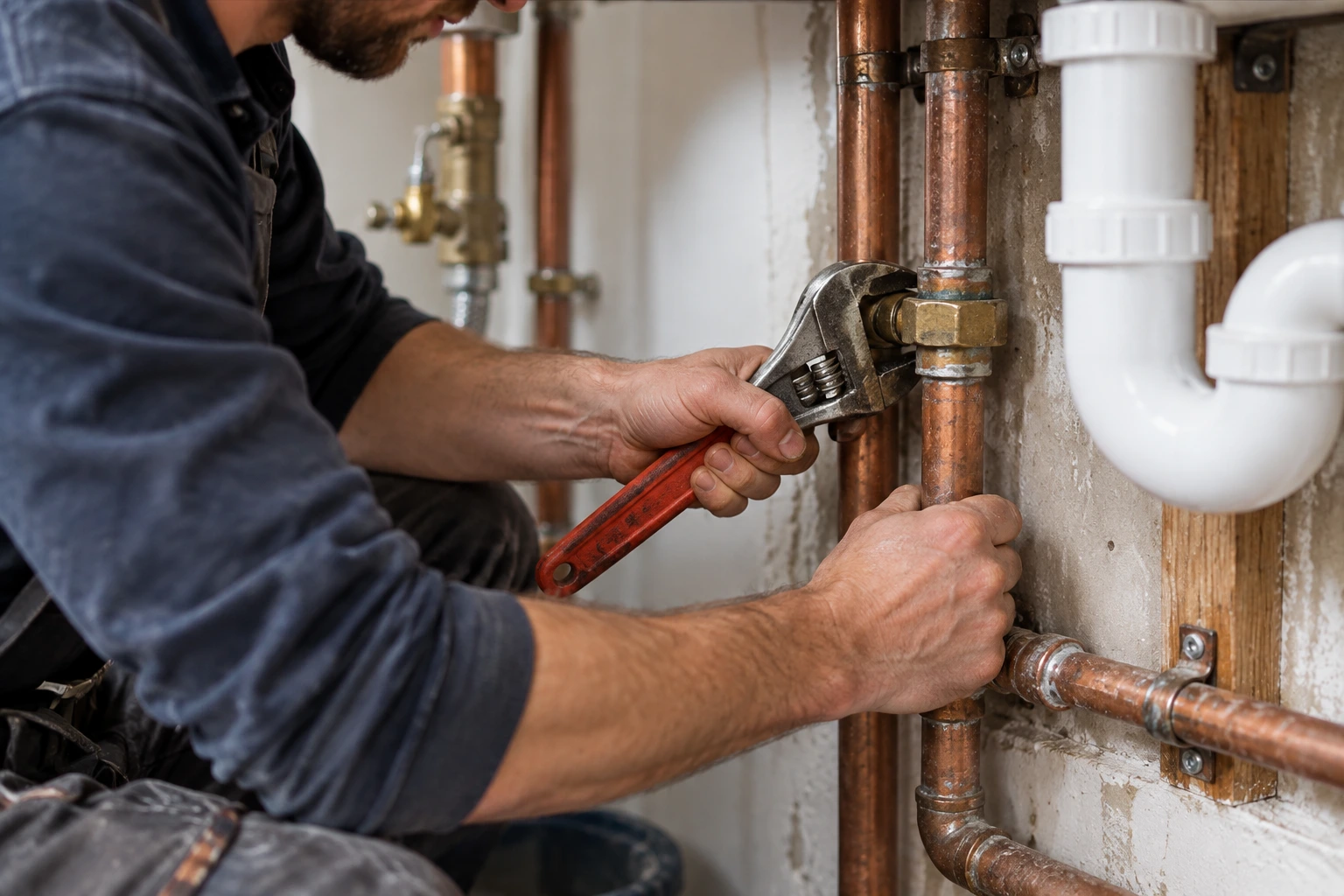
What to do first when the tank goes cold
When the showers go cold, the first job is to keep the house safe and to gather what we will ask on the phone. A garage unit sits where freeze and lawn tools both hit it, and a closet unit sits where a small leak soaks drywall before anyone looks. We will ask which fixtures went cold, whether the tank is electric or gas, and whether the area around the base is wet. That picture tells us whether this is a water heater not working, a supply issue, or a leaking water heater that needs the valve shut.
Shutoffs worth finding before we arrive
The cold water shutoff at the top of the tank is the valve that stops new water from filling a leak. On many Crowley slab houses that valve is a gate handle that has not moved in years, so we would rather operate it than have it snap in a home or business’s hand. The house shutoff is the next one if the tank valve will not turn. For an electric water heater the breaker should be off before anyone opens the access panel. For a gas water heater, leave the control alone if the area smells like fuel.
Safe checks you can do
A short look now saves a long guess later. Stay out of standing water, and do not open electrical covers with wet hands. These checks are about what you can see, not about taking the tank apart.
- Look at the floor around the tank for water before you open any panel.
- Note whether cold water still runs at the same fixtures that went lukewarm.
- Find the tank shutoff and the breaker panel so we can talk through both.
- Read the rating label for gallons and fuel type if you can see it without moving the unit.
- Feel whether the jacket is warm at the top and cooler near the bottom.
Things to leave alone
Some moves turn a small leak into a flooded garage. Leave the T&P valve, which relieves pressure on the tank, alone if you have not been shown how it should dump. The list below is the set we would rather handle on site.
- Do not reset a control over and over if the area smells like fuel.
- Do not cap or plug the T&P valve just to stop a drip.
- Do not try to drain a leaking tank into a finished closet.
- Do not put a long bar on a rusted nipple to stop a seep.
- Do not keep burning a fuel unit if the flue looks blocked.
When we arrive we will repeat those shutoff checks in the same order. That way a wet floor is handled before any panel comes off. It also keeps an electric water heater from being opened live.
Hot water heater problems we see in Crowley
Crowley tanks fail in a handful of ways that all look like no hot water until we test. Hard water, clay movement at the supply, and summer shower demand stack on the same unit. Below are the patterns we see in garages and closets, and what the house usually shows before we open a panel. Naming the pattern early keeps a small part from being treated like a whole new heater.
No hot water or not enough hot water
A house that runs out by the third shower is not always a dead tank. Scale on the lower element or a broken dip tube sends cold water to the top while the jacket still feels warm. Irrigation days make that worse because everyone showers in the same hour. We try to fix no hot water fast with readings at the tap and at the tank before anyone talks about a swap.
Signs it is time to call
- The first shower is hot and the next two are barely warm.
- Hot water never reaches the far bathroom.
- The tank jacket is warm at the top and cool near the bottom.
- Someone has already tried the reset button more than once.
- Showers fade right when sprinklers have been running.
- An electric water heater hums but the water stays tepid.
We measure incoming cold, outgoing hot, and how fast the burner or elements recover. If one element is open, heating element replacement can restore capacity without a new tank. If the dip tube is snapped, we replace that tube and retest showers. Lasater Ranch houses from the late 1990s often still have copper into a scaled tank, so we check those nipples while the access is open.
A leaking water heater
Water on a garage slab is easy to see. Water under a closet tank is not, and it can soak the plate before the stain hits a hall ceiling. A leaking water heater is a time problem as much as a plumbing problem because the pan only buys a little margin. We want the cold valve shut so the leak does not keep feeding the clay under the house.
What you might notice first
- A pan full of water under the tank.
- Drip marks on the jacket from the top fittings.
- Rust at a seam that stays wet after you wipe it.
- A T&P discharge that weeps into a bucket.
- The water heater leaking from the top around the anode or inlet.
- Soft drywall or baseboard behind a closet unit.
We dry the area enough to see whether the leak is a fitting, a valve, or the shell. Fittings and a bad pressure relief valve can be repaired. A seam leak means the tank is done. On Crowley slabs we will not hide a T&P discharge under the concrete because you cannot see a failure that runs into the Sanger soil series. Standing water that reaches finished rooms is emergency plumbing as well as tank work.
Rusty or discolored hot water
Clear cold water and stained hot water point at the tank, not the meter. The anode rod is the part that is supposed to corrode first so the shell lasts longer. When that rod is gone, rusty water from the water heater shows up in tubs and laundry. Crowley Original Town still has galvanized remnants that can stain both hot and cold, which is why the two-sided check matters.
How this shows up in the house
- Hot taps run tea-colored while cold taps stay clear.
- The first hot draw of the day is the worst.
- White towels pick up orange streaks.
- Grit collects in the aerator on the hot side only.
- The drain valve coughs brown water.
- The anode looks like a thin wire when we pull it.
Anode rod replacement can slow the rust when the lining still holds. If the drain dumps flakes and the jacket is pitted, we talk about water heater replacement as a cleaner path than another year of stained laundry. We flush after an anode change so the new rod is not sitting in old sediment. Deer Creek corridor houses with older stock get this check even when the tank looks fine from the outside.
Strange noises from the tank
Popping on heat-up is sediment dancing on a hot surface. The tank can still make hot water while it does that, which is why people wait. A water heater making loud noises is wasting heat into lime instead of into showers. Garage units seem louder because the jacket echoes off the slab and the door.
Sounds the jacket starts making
- Popping a few minutes after the burner lights.
- A low rumble that grows through the day.
- A hiss near the T&P that is not a full dump.
- Kettling that stops when you run a hot tap.
- A crackle from an electric water heater on the lower element.
- A bang when cold water hits a superheated pocket.
A water heater flush pulls the loose grit so the burner or element can touch water again. If the drain clogs with mud, the tank is packed and cleaning may not last. We inspect the anode at the same time because scale and a spent rod often arrive together. Newer PEX houses still get this lime layer from city water even when the supply lines themselves are quiet.
Pilot light and burner problems
A garage gas water heater sits in a draft, and a closet unit can starve for air when storage blocks the louver. If you smell gas or suspect a gas leak, go outside immediately and call 911. This is a serious emergency that needs urgent attention from the gas company. After the area is safe we look at the thermocouple, the pilot orifice, and the burner tray. Scale from city water is a common reason a gas water heater pilot light will not stay lit even with a fairly new control.
Clues at the burner
- The pilot will not stay lit after several tries.
- The flame is yellow and lazy instead of a tight blue cone.
- Soot streaks up the jacket or the closet ceiling.
- The unit ticks but never runs a full cycle.
- Unburned fuel smell gathers near the access door.
- Hot water works after a relight and fails again by evening.
We clean the burner, test the thermocouple, and watch draft with doors open and closed. A rusted burner tray or a cracked heat chamber is the end of a safe repair. Closet tanks along Main Street in mixed-era houses need extra air-path checks because storage and small rooms choke the flame. We do not leave a control in service if the flue is not drafting.
A water heater that will not turn on
A silent tank is a power, fuel, or control problem until the tests say otherwise. An electric water heater not working often has a tripped high-limit or a dead thermostat, not a failed shell. A fuel unit may have a control that no longer calls. We treat a water heater not working as a sequence of readings, not as an automatic replacement.
Early warnings at the heater
- No sound, no heat, and no status light.
- The breaker trips when the unit tries to heat.
- The upper thermostat clicks but the water stays cold.
- A gas water heater sits with the control set to on and no burner.
- Neighbors still have city water, so the street supply is not the issue.
- The reset button has been used more than once in a week.
Thermostat replacement and a high-limit reset restore many electric tanks that look dead. We read both elements so a single open element is not missed. If the control on a fuel unit is cooked from heat and scale, we discuss whether the tank age makes a new control a short-term patch. Builder-grade units in the 2010s wave of Crowley housing often fail at the control first.
Sediment and poor recovery
Sediment buildup is the slow version of no hot water. Moderately hard to hard water at 5 to 10 grains per gallon drops lime into the bottom of every tank on city water. Recovery stretches, showers fade, and the burner or element runs longer for the same gallon count. A water heater flush is the first mechanical step when the shell is still dry.
What the fixtures start doing
- Hot water takes much longer to return after a load of laundry.
- The tank cycles more often than it used to.
- The drain valve weeps grit when cracked open.
- Showers thin out at the end of a normal day.
- The lower element on an electric water heater fails again after a recent change.
- A faint odor on the first hot draw after a trip.
We flush with a hose to a safe drain, not into a finished closet, and we check the anode while the tank is open. If recovery is still poor, the next talk is heating element replacement or burner work, then replacement. Summer stress shows this first because lawns and showers share the same afternoon. For an older home the best water heater is often a tank we can still service, not a unit that needs a new vent path the closet cannot give.
Some Crowley houses can take a tankless water heater retrofit when the vent path is short, the gas line is large enough, and the water quality is managed for scale. A tankless water heater not heating is often a scale or vent issue, not a reason to force a retrofit onto a closet that cannot breathe. We sort that on site and keep a tank in houses that cannot vent a new unit. Houses that want the longer notes on venting and scale can read about tankless water heaters before we look at the closet.
When to repair versus replace the tank
The choice when to replace versus repair a water heater is not a vibe. It is the shell, the nipples, the elements or burner, and the supply. We show those four things in order so a home or business can see why a part is enough or why a new tank is cleaner. Age alone does not decide it, because a dry ten-year tank can outlast a seven-year tank that is already seeping at a seam.
The shell and whether it can stay
If the steel is wet at a seam, we replace. Surface rust on a jacket is not the same as a pinhole in the lining. We wipe, wait, and see whether water returns from inside. A tank that weeps from the body will not hold a repair, and putting a new anode in a wet shell only delays the same leak. On garage floors the wet ring is easy to read. In a closet we use a mirror and a dry paper towel along the bottom head.
Nipples, unions, and the pan
Nipples fail on their own, especially where copper meets steel and city water sits. A wet union can look like a doomed tank until we break it down. We replace bad nipples, dielectric unions, and drain valves when the shell is dry. The pan and the drain from that pan matter on these slabs because water that leaves the pan still has to go somewhere you can see. A pan with no drain is a bucket, not a plan.
Elements, burners, and recovery
Heat transfer is the third question. If a heating element replacement or a cleaned burner brings showers back, we stop there. If the tank is packed with lime and recovery is still poor after a flush, the interior is insulated from the heat and a new unit makes more sense. We time a recovery test so you can feel the difference at the tap, not just hear us describe it. That is also when we talk through whether to replace an old water heater that has already had two elements in a short span.
Supply, vent, and the closet itself
The last question is whether the room and the pipes can support the tank you have. A closet that cannot vent a larger unit should keep a tank size that fits. A garage with a frozen, poorly insulated line needs the line protected, or the new tank will suffer the same burst. We look at shutoffs, expansion, and the T&P path as part of water heater installation, not as extras. When those four checks agree, the recommendation is simple to follow.
How a water heater visit runs at your house
From the first call to the last temperature check, we keep the steps in an order you can follow. Crowley Plumbing Co runs this as a residential tank visit, not as a mystery. You will know what we are testing and how long that step usually takes. If the job turns into a replacement, we explain that before we pull the old unit.
What we gather on the first call
We ask where the tank sits, whether the house is slab, and whether the floor is wet. We also ask if the unit is electric or gas, and whether anyone has already shut a valve. That takes a short conversation, not a long interview. With that picture we bring the right elements, anodes, and fittings so the first visit can include water heater repair the same day when the shell allows it.
What you will see when we arrive
We protect the path from the door to the garage or closet and look for water first. The first look is usually about fifteen to twenty minutes of shutoff, power, and leak checks. We are available 24/7, so an after-hours arrival follows the same order, just with more care around lighting and neighbors. You will see us test before we cut a union or lift a jacket cover.
Testing the tank before we open it
We read temperatures, check the T&P, and confirm the control is calling for heat. On electric units we test elements and the thermostat. On fuel units we watch the burner after the area is safe. This block often takes another twenty to thirty minutes. The point is to separate a part failure from a shell failure before anyone commits to a swap.
Repair, replacement, and the last checks
A part repair is often finished on that visit. A replacement in a garage is commonly a half day, and a closet takes longer. We fill, purge air, check the T&P discharge, and read the tap temperature with you present. We leave the space swept and the old tank out of the walkway. Neighbors who want the wider residential picture can start with our Crowley plumber overview.
Where we work and what we see on tanks
Crowley clay, city water, and summer load
The Sanger soil series shrinks when it dries and heaves when it wets, so slab houses in Crowley twist the lines that feed a garage tank. That movement shows up as a dripping nipple on a tank that used to be dry. City water is purchased treated surface water and sits moderately hard to hard, so scale, not softness, is what shortens recovery. Summer lawn demand stacks on the same tanks, and low flow at fixtures shows up when everyone irrigates along FM 731.
Cresson houses and a different supply
We run the same tank tests in Cresson, but the water is not City of Crowley water. Houses off US 377 and SH 171 often keep the hot water heater in a garage on long, poorly insulated lines. Pockets outside Cresson Proper, including places served by operators other than City of Cresson, do not get a copied Crowley anode choice. Read more about plumbing in Cresson if the house sits in that town.
Questions about heat, leaks, and sediment
Why is there no hot water after the second shower in a Crowley house?
Morning demand on a tired tank is the usual story in Crowley when the first shower is fine and the next ones run lukewarm. Moderately hard to hard city water leaves sediment that covers the lower element or the burner tray, so recovery slows even if the side of the tank still feels warm. We check incoming temperature, the dip tube, and whether the tank is short for the bedroom count. A flush or a heating element replacement can restore the third shower when the shell is still sound.
Can a leaking water heater wait until morning?
A slow drip at the drain valve can wait a few hours if the pan is catching it and the shutoff still turns. Water under the tank, a wet garage slab, or a water heater leaking from the top should not wait, because water tracks along the slab and into finished rooms. Shut the tank valve and kill power at the breaker on an electric unit. We treat a wet base as urgent so the clay under a Crowley slab does not carry the leak farther than it already has.
What does rusty hot water from the taps usually mean?
Rusty hot water from the taps, with cold water still clear, usually means the tank interior or the anode is spent. Crowley Original Town still has some galvanized lines that can stain both sides, so we compare hot and cold before we blame the tank. If only the hot side is stained, we inspect the anode rod and a sample from the drain. Anode rod replacement can slow the rust when the shell is not pitted through.
What does a plumber near me check first when the hot water heater stays cold?
We start at power or fuel, then the thermostat, then whether cold water is even reaching the tank. On an electric water heater not working we read both elements and the high-limit reset before we talk about a new unit. On a fuel-fired unit we confirm the control is calling and that the flue is drafting. Only after those checks do we look at sediment, the dip tube, and mixing at the fixtures. That order keeps a simple thermostat replacement from turning into a full swap.
Why does a water heater making loud noises still produce some heat?
Popping and rumbling are usually steam pockets under sediment, not a tank that has already failed. The burner or the elements still heat water, but the lime layer makes them run hotter and louder. We drain a sample, feel how thick the grit is, and decide whether a water heater flush will help. If the drain runs rusty mud and the tank is old, cleaning is a short delay before replacement. Horse Creek Farms houses with larger lots often have longer waits for hot water when sediment has stacked for years.
Questions about fuel, parts, and replacement
Why will a gas water heater pilot not stay lit on a garage tank?
A gas water heater pilot light will not stay lit when the thermocouple is weak, the orifice is dirty, or a garage draft blows the flame. Scale also coats the burner and makes the flame lazy. We clean the burner, test the thermocouple, and watch the flame with the garage door in different positions. If the burner tray is rusted through, cleaning will not last. A closet unit with a blocked vent can mimic the same symptom, so we check draft before we leave the control in service.
How long does water heater replacement take in a garage versus a closet?
How long water heater replacement takes depends on access more than on gallons. A garage swap on a Crowley slab is often a half-day job when the drain, the vent, and the shutoff all cooperate. Closet work takes longer because we protect flooring, walk a tight tank out, and rebuild the discharge so you can see it. Pans and stands add time on older homes. We set the time window after we see the fittings, not before.
Is water heater repair for a condo different from a house?
Water heater repair for a condo still starts with the same tank tests, but access, shutoffs, and pan drains are often tucked in a small closet. We need a clear path and a place to drain, and we work inside residential units only. If building rules limit tank size or fuel type, we stay inside those rules. Closet leaks are more urgent because another unit may sit on the other side of the drywall. Scale from city water is the same physics as in a house on these streets.
Do Cresson hot water heaters fail the same way as Crowley tanks?
Cresson sits at the Hood, Johnson, and Parker county corners, and the water is not from the City of Crowley. City of Cresson serves Cresson Proper and Bluebonnet Hills, while other pockets use separate operators, so scale and odor can differ from house to house. We ask which provider bills you before we pick an anode. US 377 and SH 171 garage tanks still take freeze stress on bare runs, but we do not copy Crowley tank advice onto a different water system.
A garage or closet hot water heater that is loud, rusty, or out of capacity is residential work we handle in Crowley and in Cresson. Water heater repair, water heater replacement, and water heater installation all start with the same tests on the shell, the heat, and the supply. We keep the visit in that order so a part is not skipped and a wet shell is not patched. Houses, townhomes, condos, and businesses get that same sequence at every hour we are open.
If a buried line is split, our pipe repair work is the right path instead of another tank. If the rest of the house needs more than the heater, the full list of plumbing services is the better map. Crowley Plumbing Co stays on the tank, the shutoff nobody can find, and the slab house with the same crew. Start with the first checks if the showers are already fading, then we will take it from the door to the last temperature reading.
Reach out to us for assistance.
Service ZIPs: 76036, 76035
- NEED PLUMBING HELP?
Plumbing Problem? Call Crowley Plumbing Co Today
From clogged drains and leaking pipes to water heaters, sewer lines, and emergency plumbing, our team provides reliable plumbing service for homes.